
Why engine detection matters
Your tracker needs to know when your engine is on or off so it can:
- Go to sleep when parked (to save your battery)
- Record accurate journey data
- Send correct alerts
Most vehicles work perfectly with the default settings, but some need adjustment.
How to access engine detection settings
- Log in to your Track My Ride account at https://app.trackmyride.com.au
- Go to the Vehicles page
- Click the pencil icon next to the vehicle you want to edit
- Find Engine detection in the popup
Engine detection methods
Your tracker can detect the engine is on using different methods:
1. Voltage detection (default)
How it works:
- Engine off: Battery voltage is around 12.5V
- Engine on: Alternator charges the battery, voltage rises to around 13.5V or higher
Default setting: Engine is considered "on" when voltage is 13.2V or higher (27V for trucks)
This works for most vehicles, but you might need to adjust it if:
- Your vehicle has a high "float voltage" (some battery types naturally sit higher than 12.5V when off)
- You're using a trickle charger/battery maintainer
- You have a modern vehicle that turns off the alternator when the battery is full (for fuel efficiency)
How to adjust the voltage threshold:
Step 1: Find your vehicle's voltages
- Go to the Vehicles page
- Click on your vehicle row to expand it (or press the green + symbol)
- Look at the speed and voltage graph
- Find a section that shows both parked time and driving time
- Click and drag on the graph to zoom in
- Hover your mouse over the graph to see voltage readings
Step 2: Identify the right voltages
Look for:
- Voltage when parked (engine off)
- Voltage when driving (engine on)
Your threshold should be between these two numbers.
Example:
- Parked voltage: 12.96V
- Driving voltage: 14.59V
- Good threshold: 13.2V (default) ✓
Step 3: Change the threshold
- Edit your vehicle settings
- Choose Voltage as the engine detection method
- Click Edit next to "Engine On Voltage"
- Select the voltage threshold that sits between your parked and driving voltages
- Save
Available thresholds:
- Passenger vehicles: 13.2V, 13.4V, 13.6V, 13.8V, 14.0V, 14.2V
- Trucks (24V): 27.0V, 27.5V, 28.0V, 28.5V, 29.0V, and up to 32.0V
2. Ignition sense wire (hardwired installs only)
How it works: Uses a wire connected to your vehicle's ignition circuit.
When to use it: Best for hardwired installations where you want precise detection.
How to set it up:
- Connect the Ignition/Acc wire (pin 5 on the 2x6 connector) to a circuit that is:
- +12V or +24V when engine is on
- 0V when engine is off
- Good connection point: Your radio's power circuit
- Select Ignition sense wire as your detection method in vehicle settings
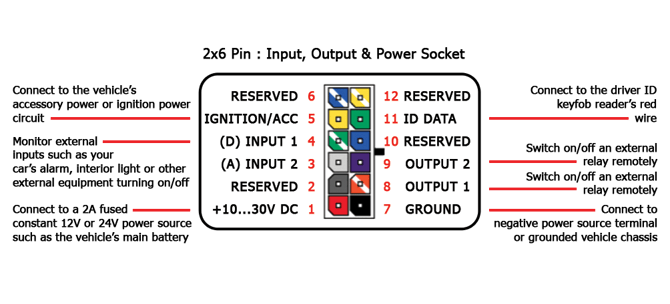 ⚠️ Important:
- Don't connect to a circuit that's always powered – your tracker won't sleep
- Don't connect to a digital signal line – check your vehicle manual
- Accessories circuit vs Ignition circuit: Accessories turns on when the key is in ACC position (engine might not be running). Ignition only turns on when engine is actually running.
3. Motion detection
How it works: Detects when the vehicle is moving.
When to use it:
- Vehicles without an accessible ignition circuit
- As a backup method combined with voltage
Limitation: May give false alerts if your vehicle is parked near constant vibrations (construction sites, heavy traffic, etc.)
4. Combination methods (recommended for tricky vehicles)
Voltage OR Motion: Engine is "on" when:
- Voltage is above your threshold (e.g., 13.2V), OR
- Motion is detected for more than 1 second
Good for: Modern vehicles that turn off the alternator when the battery is full.
Voltage OR Ignition wire: Engine is "on" when:
- Voltage is above your threshold, OR
- Power detected on ignition wire
Good for: Extra reliability in hardwired installations.
Troubleshooting
Problem: False "engine on" alerts when parked
Solution:
- Check your voltage threshold – it might be too low
- If using a trickle charger, set threshold higher than the charger's voltage
- Try a different detection method
Problem: Engine not being detected as "on"
Solution:
- Check your voltage threshold – it might be too high
- If hardwired with ignition wire, check the wire is connected to the right circuit (should be 0V when off, +12V/+24V when on)
- Use the Raw GPS Data report to check voltage readings
Special notes
Modern vehicles with smart alternators: Some newer vehicles turn off the alternator when the battery is fully charged (for fuel economy). For these vehicles, use Voltage OR Motion detection method.
Using a trickle charger: Battery chargers raise voltage to around 14V, which tricks the tracker into thinking the engine is on. Set your voltage threshold higher than the charger's output, or use a different detection method.